
 English
 Chinese (Simplified)
 French
 German
 Italian
 Japanese
 Spanish
What is the difference between an essential oil and a fragrance oil?
Only about four percent of the world's essential oil production is made to a therapeutic standard. The other ninety six percent is made for the flavour and fragrance industry, to go into shampoos, creams, candles and cleaning products. Often the same plant, grown on the same hillside. Completely different oil in the bottle.
Five things decide which one you end up with
Distillation gets the attention, and this article spends most of its time there, but it is the last of five steps and every one of them can undo the others.
1. Where the plant is grown
The same species grown at two thousand metres and at sea level produces measurably different oil. Altitude, soil, rainfall and day length all change what the plant makes. We source from thirty two countries for exactly this reason, going to the region that grows a given botanical best rather than to whoever is cheapest that season.
2. Whether the botanical species is verified
Lavender is not one plant. Lavandula angustifolia, Lavandula latifolia and the hybrid lavandin are three different oils sold under one word. Lavandin yields far more oil per hectare and costs far less, and a great deal of what is sold as lavender is lavandin. Every batch we buy is verified to species, and the species is on the label.
3. How it is cultivated
Certified organic matters here for a reason most people do not think of. Steam distillation concentrates. Anything applied to the crop that is oil soluble can travel into the finished oil at a higher concentration than it existed in the field. Growing without those inputs is the only way to be certain they are not in the bottle.
Our own certifications are held with AsureQuality since 2009 and BioGro since 2012, and both are audited annually.
4. How it is harvested
Time of day and stage of flowering change the composition. Many aromatic botanicals shed their most volatile molecules through the heat of the day, so harvest happens early. Get this wrong and the loss happens before the material ever reaches the still.
5. How it is distilled
Which is where most of the difference is either made or lost, and where the rest of this article goes.
If you have ever tasted two wines off the same grape and the same slope and wondered how they could be so far apart, you already understand what distillation does.
Hot and fast, or low and slow
Flavour and fragrance grade oil is forced off the still in fifteen to twenty minutes, under pressure at over 250 degrees. Speed genuinely suits the purpose. The large molecules carry the broad smell, they make up sixty to eighty percent of the volume, and they come over first. If your oil is going into a shampoo, that is all you need.
Staying in the still for another ten hours returns perhaps another twenty percent by weight. It also returns ten to a hundred times more of the trace molecules. Fragrance houses buy on weight, so there is no commercial reason for them to wait.
We go the other way. Eight to twelve hours at 80 to 120 degrees, no hotter than the point where water turns to steam, gentle and unhurried. Far less oil per hour on the still and far more cost per litre, and that is exactly the point. The slow run coaxes out everything the plant made, not just the loud part of it.
Why the temperature matters as much as the time
Heat does two things at once. It drives the molecules out of the plant material, and past a certain point it starts breaking them apart. The delicate trace molecules are the first to go. A run that is fast because it is hot is not just leaving those molecules behind, it is destroying some of the ones it does collect.
Low and slow avoids both problems. Nothing is cooked, and everything has time to come across.
The arithmetic, plainly
A still that could turn out four fast batches in a day turns out one of ours. The labour, the fuel and the plant material are much the same either way. That is the whole of the price difference, and it is why a properly distilled oil will never compete on shelf price with something run off the still in twenty minutes.
How to read a gas chromatogram
A gas chromatogram is the chart that shows every molecule inside an oil. It is the blueprint we hold every batch against, and once you can read one you can never quite look at a label the same way again.
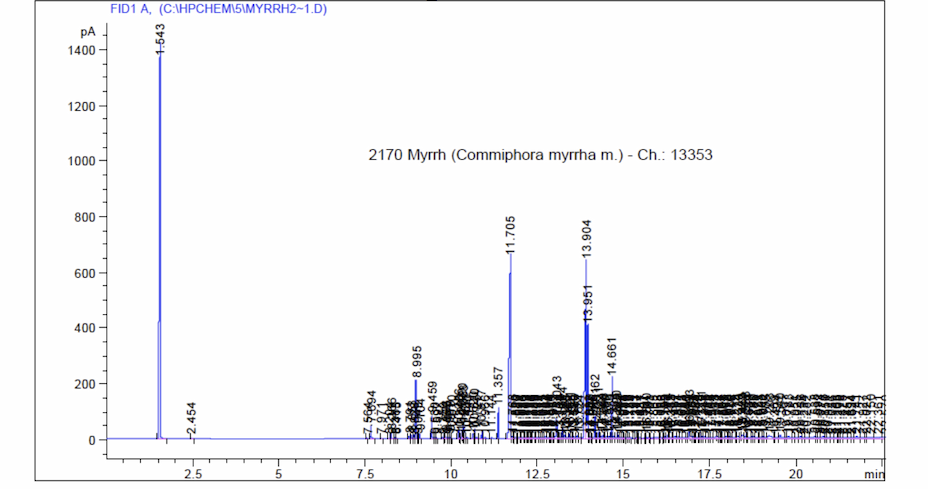
The horizontal axis is time, in minutes. A small sample of the essential oil is vaporised and pushed through a long narrow column. Light, volatile molecules travel fastest and come out first, on the left. Heavier ones lag behind and arrive later, on the right. The detector at the far end records whatever comes past.
The vertical axis is how much of it arrives. A tall peak means a lot of that molecule, a short one means a trace. Each peak is labelled with the minute it appeared, and that timing is what identifies it.
What to actually look at
- The tall peaks at the front. The major molecules by volume, the ones a fast distillation is after, and much the same whoever distilled it.
- The long tail behind them. Dozens or hundreds of tiny peaks. Sesquiterpenes, and in the more complex oils even diterpenes. This is the part that separates a good oil from an ordinary one.
- Peaks that should not be there. Adulteration shows up as molecules out of place. A synthetic added to boost a weak batch appears as a peak with no business in that profile. And adulteration is not always synthetic. Rose oil naturally contains a portion of rhodinol, and rhodinol drawn out of geranium oil costs a fraction of rose, so a supplier can stretch rose with geranium's rhodinol and every molecule in the bottle is still natural. The ratio is what gives it away.
- Peaks that should be there and are not. Just as telling. A missing marker molecule usually means the run was cut short.
Two oils from the same species can have near identical front ends and completely different tails. On a shelf they look the same, and the price tag will not tell you either, because some brands price an ordinary oil high knowing that a high price is read as proof of quality. On a chromatogram the difference is obvious in a second.
Myrrh, a worked example
Myrrh is a good oil to learn on because it is one of the most complex we handle. It is a resin rather than a leaf or a flower, and resins hold on to their heaviest molecules hardest.
On our myrrh profile the front end is dominated by a small number of tall peaks arriving in the first few minutes. Then, from roughly seven minutes onward, the trace region begins, and it does not stop. Sesquiterpenes through the middle, and out at the far end a scattering of diterpenes, heavy enough that a fast run never reaches them at all.
Those late molecules are a large part of why myrrh smells the way it does: warm, resinous, and slow to fade. A fifteen minute myrrh distillation produces something recognisably myrrh, and almost none of that depth.
How you can smell the difference
You do not need a laboratory. The difference is available to anyone with a nose and two bottles from different brands.
A flavour and fragrance grade oil tends to smell sharp and then sit flat. It arrives all at once and it is gone just as quickly. That strong first hit is very often mistaken for quality. It is really just the big molecules arriving on their own, loud and aggressive, with nothing behind them.
A slow distilled oil is deeper and rounder, and it stays with you. It moves as it evaporates, because different molecules leave at different rates. There is simply more of the plant in the bottle, and that is where the plant's therapeutic value lives.
Try this
Put one drop of each on separate strips of paper. Smell both immediately, then again at ten minutes, then again at an hour. The fast oil will be much the same at ten minutes and gone by the hour. The slow one will have changed twice and still be there.
Once you have used a properly distilled essential oil, the flavour and fragrance grade ones smell thin and overpowering by comparison. The wine comparison holds all the way through. You will not go back.
Six things any good supplier will show you
None of these are secrets. A brand that is proud of its oil puts them where you can see them, without being asked.
- The full botanical name, the species, and where it matters the chemotype.
- The country of origin.
- Independent certification, with the certifier named. A stamp a brand awards itself is not a certification.
- The key molecules, published openly. We list them on every product page.
- The extraction method.
- A best before date. Very few companies can put one on a bottle, because standing behind a date takes real knowledge of the oil inside it.
Beyond the label, look at the whole of the company. How transparent the information is, how professionally it is presented, whether a person or a chatbot answers your questions, who founded the brand and who owns it now, and how the oil is sold. A brand doing all of this in the open has nothing to hide.
Common questions
Is a fragrance oil the same as a synthetic oil?
Very likely, yes. Fragrance oil usually means an imitation of a fragrance made in a laboratory, no plant required. This is why the industry name matters: the flavour and fragrance industry also buys real plant oil, distilled fast for shampoos, creams and cleaning products. A quickly distilled plant oil and a lab-made imitation are both legitimate products for their purpose. Neither is what we make.
Does more expensive always mean better?
No. Price follows yield as much as it follows quality, which is why rose is dear and orange is cheap regardless of who distilled them. And a high price on its own proves nothing, because some brands price ordinary oil high knowing it will be read as quality. Look at the company, the transparency and the certifications, then trust your nose. The paper strip test above works anywhere.
What does therapeutic grade actually mean?
On its own, very little. There is no independent body that awards it, so any brand can print it. What can be verified is the botanical name and species, the country of origin, the certifier, the extraction method and the best before date. Those are the claims worth reading.
Why do two bottles of the same oil smell different?
Season, weather and harvest timing vary from year to year, so a genuine single origin oil should vary a little between batches. An oil that smells identical every single year has usually been standardised to a target, which means something was added or taken away.
How long does a pure essential oil keep?
Stored cool, dark and tightly capped, most keep for years, and some resins and woods improve. Citrus oils are the exception and are best used within a year or two of opening. Shelf life and best before dates deserve more than a paragraph, so they are getting a Need to Know of their own.
Where to start
Every Absolute Essential oil is distilled low and slow, and every batch is held against its own gas chromatogram before it is bottled. Precision crafted in New Zealand, at our solar powered facility at Muriwai Beach.
Browse the essential oils. Every product page carries the botanical name, the origin and the key molecules, and the encyclopedia goes deeper on each plant. The batch number on your box and label ties every bottle back to its records, which is part of what organic certification asks of us.
This is part of our Need to Know series, where Dr Bo Hendgen DO ND AM answers the questions people actually ask about how essential oils are made and used. Have one of your own? Ask us and it may become the next edition.
Ngā mihi
Dr Bo Hendgen DO ND AM