
 English
 Chinese (Simplified)
 French
 German
 Italian
 Japanese
 Spanish
How do you choose a good essential oil brand?
is designed to sell.
Six things a good essential oil label will always tell you, and four more that are not printed anywhere. None of it asks you to take a company's word for anything, including ours.
The front of the bottle is designed to sell. The back is where a brand goes on the record, and so is their product page. What a company leaves off both tells you more than anything it prints.
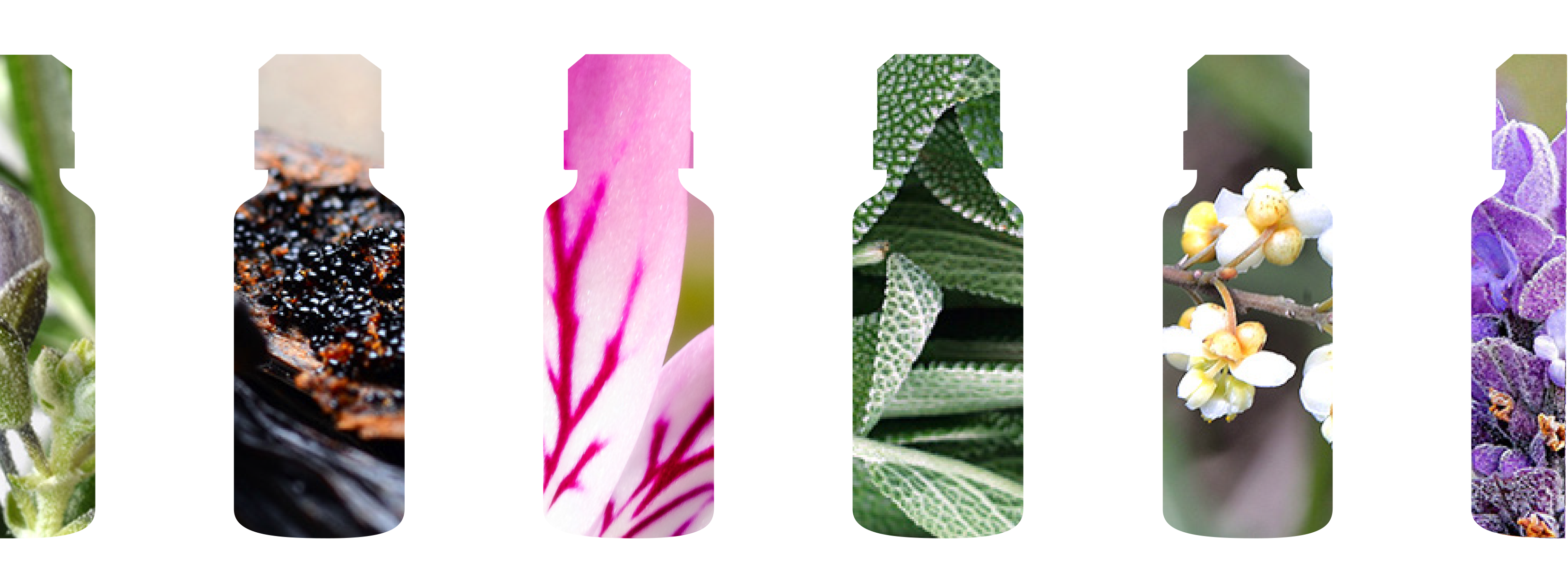
Every bottle is a plant, a species and a place. The label is where a brand tells you which.
What should a good essential oil label always tell you?
Six things: the full botanical name, the species, the country of origin, the extraction method, the key molecules, and a best before date.
The botanical name and the species. Lavender is not one plant. Lavandula angustifolia and Lavandula latifolia are both lavender, they smell different, and they behave differently. A common English name on its own tells you almost nothing about which one is in your hand. Where the chemistry varies within a species, the chemotype matters as well, and a company that knows its material will publish it.
Country of origin. The same species grown in two countries gives two different oils, because soil, altitude, climate and harvest timing all move the chemistry. Origin is not a marketing flourish, it is part of the specification. We source from 32 countries and name the origin on every oil.
Extraction method. Steam distillation, cold pressing and solvent extraction produce materially different results from the same plant. If a label does not say, you cannot judge what you are holding.
The key molecules. The molecules are the actual claim. Everything else is description. A company that publishes its key constituents openly is telling you what is in the bottle rather than how it feels about it. We list them on every product page.
A best before date. This is the one that separates most of the market. A best before date is a commitment, and it can only be made by a company that knows when the oil was distilled, how it has been stored, and how it behaves over time. Very few can stand behind one.
What does 100% pure actually mean?
Pure, and every ingredient named. Pure is not only about dilution, it is about disclosure. Our single oils and carrier oils are 100% pure and exactly what the botanical name says. Our pure blends are 100% essential oil, with no fillers or extenders. We hold one best quality of each variety, and that is the one that goes into every product we formulate. In the creams, lotions, gels and massage oils, every ingredient is named.
Nothing hides behind the word Fragrance, and that word is where a great deal gets hidden across this industry. One line on a label can stand in for dozens of undeclared compounds, and it is entirely legal. If a label uses it, it is telling you there is something it is not naming.
Do certification badges mean anything?
Only when the certifier is named.
A named certifier can be looked up, and the licence checked, by anybody, in about a minute. A self declared badge is a graphic somebody made. The two look almost identical on a bottle and they are not remotely the same thing.
Ours are AsureQuality, certified since 2009, and BioGro, certified since 2012.
There is a second question worth asking, and almost nobody asks it: does the certification cover the whole range, or a collection inside it? A brand can hold genuine organic certification over a handful of products and present it as though it describes the company. Ours covers the company and the whole range. Because the company itself is audited rather than a product line, the audit reaches further than most people expect. Even the cleaning products we are permitted to use around the oil are controlled, so what sits near the oil is held to the same standard as the oil. And because that same standard runs through everything we do, the factory it is all made in, at Muriwai Beach, Aotearoa, runs on solar.
Does a higher price mean a better oil?
No, and it does not work in reverse either.
Price tells you about positioning. Some brands price ordinary oil high precisely because a high price reads as quality, and a fair price can sit behind a very good oil.
Sometimes price tells you about the selling model rather than the oil. Where a product passes through several layers of sellers before it reaches the person using it, every layer has to be paid from the same bottle, and that cost sits in the price rather than in the quality of the oil. That is a structural fact about how a product is sold, and it is worth understanding when you are comparing two bottles that look similar.
Judge a company on what it transparently delivers, not on what it charges.
What sits beyond the label?
Four things that are not printed anywhere, and they are often more revealing than the label.
How openly the company shares information. Ask something specific and difficult. The answer, and how quickly it comes, tells you most of what you need.
Whether you reach a person. A company that will put you in front of someone who knows the material is making a different promise than one that routes you to a chatbot.
Who founded the brand, and who owns it now. Ownership shapes decisions. It is usually findable, and when it is not, that is itself an answer.
How it is sold. A brand that recruits sellers is answering to a different set of pressures than one that answers to the person using the oil.
What does adulteration actually look like?
It is rarely as crude as adding something synthetic. The more common version is subtler and much harder to catch.
Rose oil naturally contains a portion of rhodinol. Rhodinol can also be extracted from geranium, where it is far cheaper. So rose oil can be bulked out with geranium derived rhodinol and every molecule in the bottle is still natural. Nothing has been faked. The ratio is simply wrong, and the oil is no longer what the label says it is.
This is why the six checks matter. Species, origin, method and published molecules together make that kind of substitution difficult to hide. A common name and a nice bottle make it easy.
The short version
Before you buy any essential oil, from anyone, look for these six:
- The full botanical name and species
- The country of origin
- The extraction method
- The key molecules
- A named certifier, not a self declared badge
- A best before date
Then check that every ingredient is named, and that nothing hides behind the word Fragrance. And ask the four questions that are not on the label. If a company answers all of it comfortably, you are dealing with people who know their material.
Need to Know is our series answering the questions people actually ask about essential oils, one at a time, without the marketing. Precision crafted in New Zealand.
Have a question you would like answered? Ask us and it may become a future edition.